Evaluating the Water Color Photoshop Brush Set-4 for Professional Digital Art
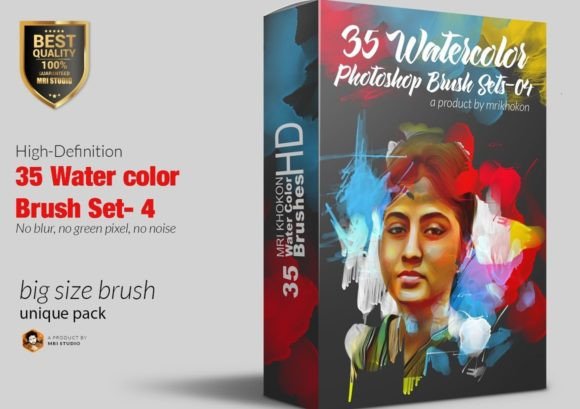
In the realm of digital illustration, the quest for textures that authentically mimic traditional media remains a persistent challenge for artists and designers. The Water Color Photoshop Brush Set-4 emerges as a specific resource designed to address this need, offering a collection of 35 high-quality, hand-painted watercolor wash brushes. With each brush rendered at a substantial 1500 pixels size, this pack aims to provide the resolution and detail necessary for large-scale projects without the degradation often seen in smaller assets. For professionals aged 20 to 50 who are weighing various tools for their workflow, understanding the technical specifications, practical applications, and comparative value of this set is essential before integrating it into a creative pipeline.
Technical Specifications and Asset Quality
The primary distinction of the Water Color Photoshop Brush Set-4 lies in its technical construction. Unlike many generic brush packs that rely on low-resolution scans or algorithmic generation, this collection emphasizes a "big size" approach. Each of the 35 brushes is defined by a 1500-pixel diameter. This dimension is critical for maintaining edge fidelity when scaling up artwork for print or high-definition digital displays. In standard workflows, using small brushes (often under 500 pixels) and scaling them up can introduce unwanted artifacts, such as pixelation or jagged edges, which disrupt the illusion of fluid paint.
Furthermore, the pack explicitly addresses common quality issues found in free or budget resources. The description highlights a "No blur, no green pixel, no noise" guarantee. In digital imaging, "green pixels" often refer to chromatic aberration or compression artifacts that appear when images are heavily processed. Similarly, noise can interfere with the smooth gradients required for realistic watercolor effects. By ensuring these elements are absent, the Water Color Photoshop Brush Set-4 provides a clean canvas for layering colors. The inclusion of 30 additional Photoshop art brushes within the ABR format expands the utility beyond just washes, allowing for varied stroke types within a single file structure.
Understanding the Hand-Painted Wash Technique
The core of this set is the "hand-painted watercolor wash." This technique differs significantly from procedural texture brushes. Procedural brushes use mathematical algorithms to generate randomness, which can sometimes look repetitive or artificial upon close inspection. In contrast, hand-painted sources capture the organic irregularities of real pigment interacting with paper. When an artist utilizes the Water Color Photoshop Brush Set-4, they are essentially stamping or dragging a captured moment of traditional painting. This results in natural variations in opacity, pigment density, and edge softness that are difficult to replicate synthetically. For projects requiring a tactile, human touch—such as book covers, editorial illustrations, or concept art—this authenticity is often the deciding factor.
Comparative Analysis: Alternatives and Market Position
When evaluating the Water Color Photoshop Brush Set-4, it is helpful to compare it against other categories of digital watercolor tools available in the market. The landscape generally divides into three main approaches: procedural simulation engines, stock photo overlays, and scanned brush sets like this one.
- Procedural Simulation Engines: Many modern software packages include built-in wet-media engines that simulate the physics of water and pigment. These are powerful but require significant hardware processing power and a steep learning curve to master. They allow for infinite variation but lack the specific character of a pre-defined style. The Water Color Photoshop Brush Set-4 offers a middle ground, providing immediate stylistic consistency without the computational overhead.
- Stock Photo Overlays: Another alternative involves using high-resolution photographs of actual watercolor paper or paint swatches as overlay layers. While effective for adding texture, this method limits the artist's ability to control the flow and direction of the paint. It creates a static background rather than an interactive tool. The brush set allows for dynamic application, where the artist controls the pressure, angle, and flow.
- Generic Free Packs: Numerous free brush packs exist online, but they often suffer from inconsistent sizing and lower resolution. A common limitation is the inability to scale without losing definition. The 1500-pixel specification of this set positions it above the average free resource, making it more suitable for professional-grade output where client expectations regarding image clarity are high.
Tradeoffs in Workflow Integration
While the Water Color Photoshop Brush Set-4 offers distinct advantages, there are tradeoffs to consider. The reliance on pre-painted shapes means that the variety is limited to the 35 included designs. If a project requires highly specific, unique splatter patterns that do not exist in the pack, the artist may need to supplement this with custom-created brushes or other resources. Additionally, because the brushes are designed to mimic a specific "wash" style, they may not be suitable for every type of watercolor effect, such as dry-brush techniques or hard-edge ink lines, unless the supplementary 30 art brushes cover those bases adequately.
Another consideration is the file format compatibility. The pack is distributed as an ABR (Adobe Brush Resource) file. While this is the standard for Adobe Photoshop, it does not natively work in non-Adobe ecosystems like Procreate or Clip Studio Paint without conversion. Professionals working in a multi-software environment must weigh whether the investment in learning a converter or creating duplicate assets is worth the specific aesthetic benefits of this pack.
Best-Fit Situations and Decision Factors
Determining whether the Water Color Photoshop Brush Set-4 is the right choice depends largely on the specific goals of the project and the artist's existing toolkit. This resource is particularly well-suited for scenarios where speed and stylistic consistency are paramount.
Ideal Use Cases
- Rapid Concept Generation: Designers needing to create mood boards or initial concepts quickly will benefit from the ability to apply complex watercolor effects in seconds. The pre-configured settings eliminate the time spent tweaking brush dynamics manually.
- High-Resolution Print Work: Due to the 1500-pixel size and HD guarantee, this set is appropriate for posters, packaging, and large-format prints where low-resolution textures would fail under scrutiny.
- Graphic Design Elements: Marketers and graphic designers often need watercolor accents for backgrounds, logos, or promotional materials. The "no noise" and "no green pixel" features ensure these elements remain clean when placed over text or vector graphics.
- Texture Layering: Artists who build images through multiple layers of transparency will find the wash brushes effective for creating depth without obscuring underlying details.
When to Consider Alternatives
Conversely, there are situations where this specific pack may not be the optimal solution. If an artist requires total control over the fluid dynamics of the paint—simulating how water actually spreads and bleeds in real-time—a dedicated wet-media engine might be superior. Similarly, if the project demands a highly abstract or experimental style that deviates from traditional wash aesthetics, the fixed nature of these 35 brushes could feel restrictive.
Budget-conscious hobbyists who only work on small social media graphics might also find the high resolution unnecessary, as smaller files load faster and consume less disk space. In such cases, a lower-resolution pack or a simpler procedural brush might suffice. Furthermore, if the workflow relies heavily on non-Adobe software, the effort required to convert the ABR files might outweigh the benefits, prompting a search for native formats instead.
Practical Implementation Strategies
To maximize the utility of the Water Color Photoshop Brush Set-4, users should adopt a layered approach. Rather than relying on a single brush to create an entire image, combining the wash brushes with the supplementary art brushes can yield richer results. For instance, one might use a broad wash brush to establish the color field and then utilize a finer, textured brush from the same pack to add highlights or shadows. This mimics the traditional process of wet-on-wet followed by dry detailing.
Color management is another key factor. Since the brushes are designed to be transparent and blendable, they respond well to Photoshop's blending modes. Experimenting with "Multiply," "Overlay," or "Soft Light" can drastically alter the appearance of the watercolor effect, allowing a single brush to serve multiple purposes. However, users should remain mindful of the "HD No blur" claim; while the source is sharp, excessive blurring filters applied after the fact can negate the crispness of the original design. Preserving the integrity of the brush strokes during post-processing is crucial for maintaining the professional finish intended by the pack creators.
Final Assessment
The Water Color Photoshop Brush Set-4 represents a specialized tool for digital artists seeking efficiency and high-fidelity texture. Its strengths lie in its resolution, the absence of common digital artifacts, and the authentic feel of hand-painted sources. While it may not replace the versatility of procedural engines or the infinite variability of custom creation, it fills a specific niche for professionals who need reliable, high-quality watercolor effects without the associated time costs. By understanding its capabilities and limitations, artists can make an informed decision on whether this pack aligns with their specific project requirements and workflow preferences.